


Matei Basarab Technical High School is a Vocational Education and Training (VET) upper secondary education organization located in Caracal city, Romania. The school is a public educational institution under the Romanian Ministry of Education and Research.
Its mission is to provide students from Caracal city and surrounding rural communities with qualifying educational opportunities that are diverse, open, flexible, and inclusive. The goal is to facilitate their access to the local, regional, national or European labour market as qualified workers or technicians.
The school offers two main forms of education, day and evening classes, in three different curricula programmes. The first curricula programme offered by Matei Basarab Technical High School is the four-year technological programmes, for grades 9 to 12. This level provides the graduates with access to higher education based on the baccalaureate diploma and/or access to the labour market as qualified technicians in the professional qualifications of six occupational domains. These include mechanics, electrics, textile, tourism and food industry, economic and services, and aesthetic and human body hygiene.
The second curricula programme is the three-year school-based or dual VET programmes that provides the graduates with specialized knowledge, skills and competences related to qualifications from the previous specified occupational domains. This gives students the option of working as qualified workers and/or continuing studying at high school level (11 and 12 grade) after graduation.
The first two levels described are based on combining VET and general education and target secondary students for initial VET. According to the National Qualification Framework (NQF), these are corresponding reference levels of the European Qualification Framework (EQF) at 4 EQF and 3 EQF respectively (Cedefop, 2019).
The third level of day education is the three semesters post-secondary VET programmes which provide the graduates with superior specialized competences in mechanics that allow them working as specialized technicians, 5 EQF.
Furthermore, the school offers evening classes that target adult students for the five-year technological programmes, from grades 9 to 13, which is equivalent to the level of the regular grades 9 to 12. Graduates are provided with an upper secondary school leaving diploma and/or the EQF level 4 ‘technician’ qualification in services or technical studies and/or with a baccalaureate diploma in the case as they participate to the baccalaureate exam and succeed.
In 2017-2018 school year there were enrolled 1360 students from whom 1001 students in day classes and 359 students in evening classes. A number of 770 students were enrolled in the four-year technological programmes in day classes and 359 in evening classes which is a total of 1129 students at EQF 4. In addition, in day classes, there were enrolled 176 students in three-year school-based or dual VET programmes (EQF 3), and 55 students enrolled in the three semesters post-secondary VET programme (EQF 5).
In 2018-2019 school year there were enrolled 1274 students from whom 901 students in day classes and 373 students in evening classes. A number of 711 students were enrolled in the four-year technological programmes in day classes and 373 in evening classes which is a total of 1084 students at EQF 4. In addition, in day classes, there were enrolled 134 students in three-year school-based or dual VET programmes (EQF 3), and 56 students enrolled in the three semesters post-secondary VET programme (EQF 5).
According to the EU policy in the field of vocational education and training (n.d.), ”Vocational education and training is a key element of lifelong learning systems, which equip citizens with knowledge, skills and competences required in particular occupations and on the labour market”.
According to Cedefop (2019), the levels of the Romanian education system are visually highlighted in the following picture. Cedefop is the European Centre for the Development of Vocational Training. Its mission is ”helping the European Commission, the EU Member States and the social partners to develop the right European VET policies” (About Cedefop, n.d.).Romanian organization responsible for developing VET at the national level is the National Centre for Technical and Vocational Education and Training Development (http://www.tvet.ro/).
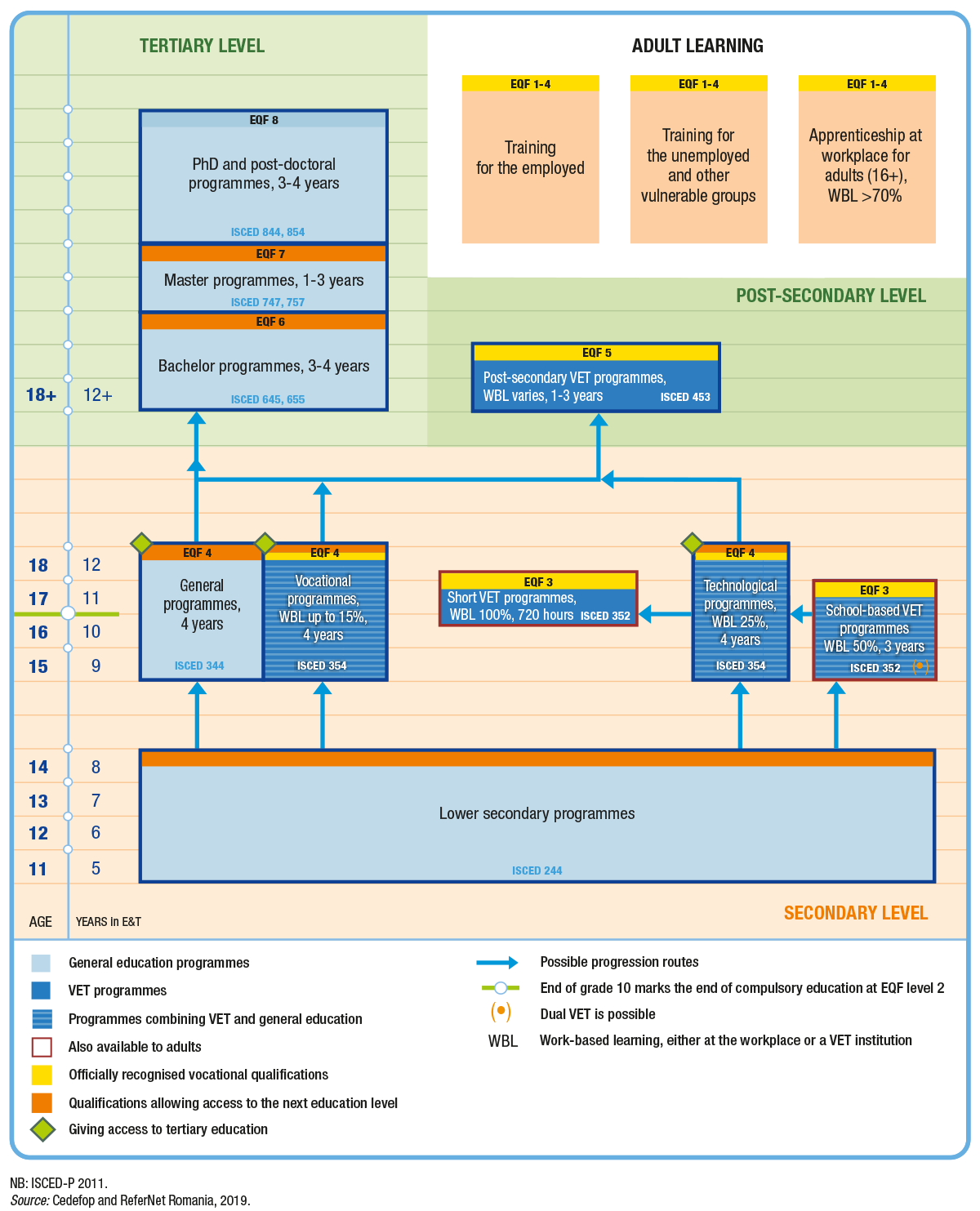
SOURCE:https://www.cedefop.europa.eu/en/tools/vet-in-europe/systems/romania
Reference list
About Cedefop. (n.d.). Cedefop. Retrieved February 15, 2020 from
https://www.cedefop.europa.eu/en Cedefop (2019).
Vocational education and training in Romania: short description. Luxembourg:
Publications Office. http://data.europa.eu/doi/10.2801/256780
EU policy in the field of vocational education and training. (n.d). European Commission-Education and training. Retrieved February 14, 2020 from